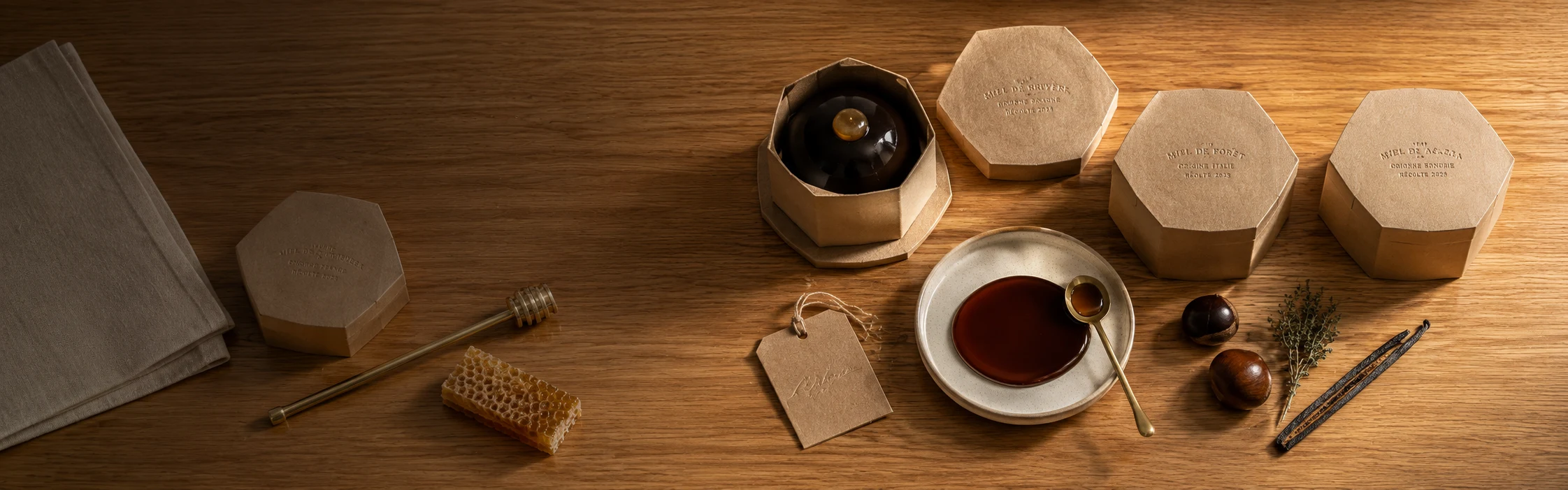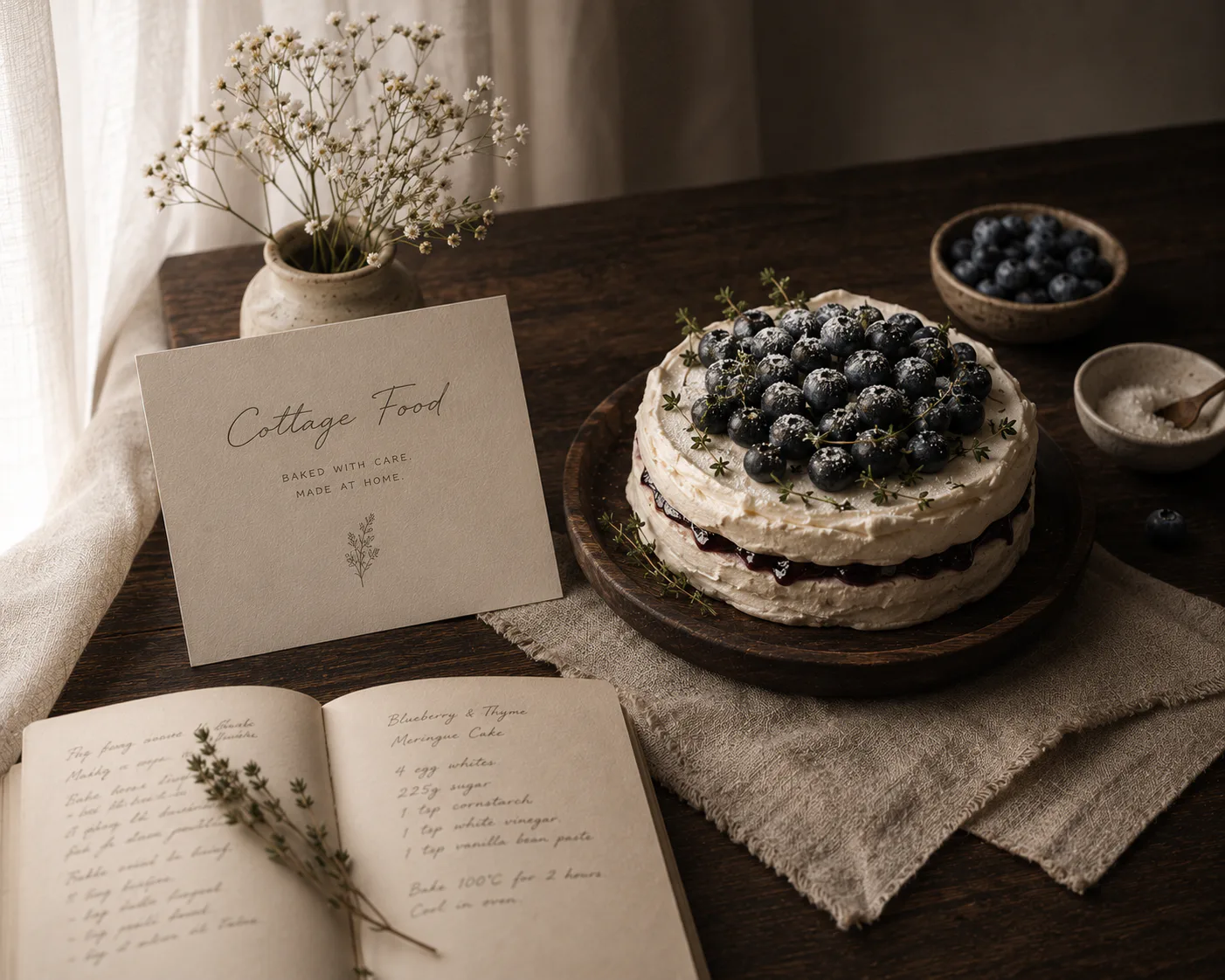
The Vespre is built for the hour that does not rush — late afternoon, the end of a meal, a Sunday in November, a Tuesday morning that belongs to no one. The maison releases its work in seasonal capsules, never repeated, made by one chef in one kitchen. What follows is the shape of that practice.
If you have a question that is not answered here, please email us at legal@thevespre.com.
— Lana Sanders, The Vespre
Contents
- Why we chose this model
- Le mode opératoire
- What we make
- What we do not do
- The framework — Texas SB 541
- What we do not sell, and why
- Where the work is made
- The statutory disclosure
- TCS items — extra protections
- Food handler certification
- Where we sell, and how it travels
- Looking forward — early 2027
- References and verification
1. Why we chose this model
The cottage food framework is not where the maison ended up. It is where the maison was always going to begin. The work is composed by one chef, built in one kitchen, finished by hand. Capsules are small because the season requires what a season requires, and no more. Pieces are released in counted runs. The scale is the design.
Texas cottage food law — as expanded by Senate Bill 541, effective September 1, 2025 — mirrors, in its structure, the constraints the maison would impose on itself in any state. One operator. Direct relationship with the customer. No anonymous distribution chain. The framework does not loosen the practice; it formalizes it.
In the first quarter of 2027, the maison opens its first room. The kitchen moves from a residence to a counter; the seasons continue, the capsules continue, the discipline continues. The address changes; the practice does not.
2. Le mode opératoire
The unit of the maison's calendar is the capsule. A capsule is a small body of work — seven pieces composed around a single seasonal idea — released as a complete set and never repeated. Each year contains five: Hiver, Spring, Summer, Fall, and Holiday. Le Rucher is the first.
A capsule opens by announcement. Some weeks before the season begins, the maison publishes the capsule's name, its components, and the dates on which it will be available. A waitlist is collected; on the opening date, those on the waitlist are invited to reserve first, and the remainder is released to the public. Reservations close when the capsule's counted runs are full. Pieces are produced in sequence over the run of the capsule and collected by appointment, delivered within Houston, or shipped where the form allows. When the season ends, the capsule closes. The same composition will not return.
Commissioned work — Les Gâteaux de Cérémonie — moves on its own clock. Wedding and celebration cakes are designed in conversation with the client, typically two to six months ahead of the event. The capsule and the commission are two threads of the same practice; they share the kitchen and the hand, but they do not share the calendar.
3. What we make
The Vespre is a maison of three forms: les petits gâteaux — composition work at the scale of a single serving; les entremets — the same craft at whole-cake scale; and les chocolats — single-origin bonbons, ganaches, and pralinés. The maison does not make viennoiserie. The morning hour is not ours.
The tradition the maison draws from is fundamentally a tradition of cream, custard, and mousse — components that require refrigeration. For most of its history, Texas cottage food law excluded these forms from direct-to-consumer sale outside a commercial license. Senate Bill 541, effective September 1, 2025, opened the law to them. The Vespre exists in the window the law opened: a maison practicing classical pâtisserie under a framework that has only just begun to allow it.
— Les Petits Gâteaux. The maison's most common form. Multi-component compositions at the scale of a single serving — typically the principal body of a capsule.
— Les Entremets. The same compositional craft at whole-cake scale, with the same layered work in cream, mousse, gel, and crémeux. Entremets appear in capsules where the season calls for a whole-cake form.
— Les Chocolats. Bonbons, ganaches, and pralinés built around single-origin sourcing. In every capsule, chocolat appears among the seven pieces — sometimes as one, sometimes as several — as part of the season's composition, not as a separate line.
— Les Gâteaux de Cérémonie. Wedding, celebration, and commissioned cakes, produced on commission only. Designed in conversation with the client and built in the voice of the season's capsule.
Each category is approached as a study, not a catalogue. What is made, what is dissolved, what is never repeated — the archive is the work.
4. What we do not do
There is no retail counter at the maison. There are no walk-ins, no display cases, no menu pinned to the wall. Capsules are announced; orders are placed; pieces are collected or delivered. Discovery is by reservation, by waitlist, by the slow circuit of those who follow the seasons. A maison is not a storefront. The work belongs to the room behind it, and the room behind it is a kitchen.
The Vespre does not scale. Capsules are limited to what one chef can compose, one kitchen can produce, and one signature can stand behind. The numbers are chosen because they are the numbers one chef can watch. Pieces sold beyond that threshold are different pieces — work done at a distance, finished by someone else, signed off by no one in particular. That is a different practice. It is not the practice of this house.
5. The framework — Texas SB 541
The Texas Cottage Food Law (Texas Health & Safety Code Chapter 437) is the legal framework that authorizes individuals to produce certain foods for direct sale from a private residential kitchen, without operating under retail food establishment licensing. The law was first enacted in 2011, narrowed in 2013, and substantially expanded by Senate Bill 541, effective September 1, 2025.
Cottage food operations are not unregulated. They are subject to a specific set of rules covering what may be produced, how it must be labeled, where it may be sold, how much may be sold in a year, and what training the operator must complete. Cottage food operations are exempt from routine governmental inspection — but the framework defines, in writing, the practices the operator must follow.
The Vespre operates under the current (post-SB 541) regime, not the older 2019 statute. The most relevant changes for a pastry house:
Annual revenue ceiling raised. From $50,000 to $150,000 gross per household per calendar year, indexed for inflation beginning in 2026.
Exclusion model instead of allowlist. Producers may now sell any food except those on a short prohibited list (see Section 6).
Time/Temperature Control for Safety foods are now legal direct-to-consumer. With proper registration, producers may sell items requiring refrigeration — mousses, custards, cream-filled pastries, cheesecakes, crème pâtissière, items previously banned entirely. This is the single most important change for the maison; the work it does is, by composition, fundamentally TCS.
In-state Texas shipping is permitted via licensed common carriers (USPS, UPS, FedEx). Third-party couriers (DoorDash, Uber Eats, Postmates, and similar) are not permitted regardless of food category.
Online sales are permitted through the producer's own website.
Local jurisdiction is preempted. Houston and Harris County may not require permits or licensing fees specific to cottage food, may not inspect home kitchens absent reasonable cause, and may not restrict cottage food operations through targeted zoning. General residential zoning still applies.
Required label language was rewritten. The verbatim statutory disclosure appears in Section 8.
6. What we do not sell, and why
Senate Bill 541 lists categories that may not be sold under cottage food regardless of any other provision:
- Meat and meat products
- Poultry and poultry products
- Seafood, fish, shellfish, and their products
- Ice products — ice cream, gelato, popsicles, frozen custard, shaved ice, sorbet
- Raw milk and raw milk products
- Low-acid canned goods (certain pickles, certain vegetable salsas)
- Products containing CBD, THC, or other regulated cannabinoids
These categories require commercial-kitchen licensing for direct sale. The maison does not produce most of them and never intended to. The single category that is operationally relevant is ice products — sorbets and ice creams are part of the pastry repertoire that will be introduced after the transition described in Section 12.
7. Where the work is made
The Vespre operates from a private residential kitchen in Houston, Harris County, Texas, registered with the Texas Department of State Health Services as a Class B Cottage Food Production Operation (Class B is the designation that authorizes TCS food production under SB 541).
The kitchen is single-chef. There is no production line, no shift, no staff outside the operator and household members assisting under the cottage food framework. Every batch is watched.
DSHS registration number: pending DSHS registration (the number replaces the home address on every product label for privacy, per §437.0195).
The kitchen is not subject to routine governmental inspection — this is a feature of the cottage food framework, not an exception we have negotiated. The framework substitutes operator self-discipline and clear statutory disclosure for inspection. See Section 8 for the required text every customer sees.
8. The statutory disclosure
Texas Health & Safety Code §437.0193 (as amended by SB 541) requires every cottage food product to carry the following statement, verbatim, in capital letters:
THIS PRODUCT WAS PRODUCED IN A PRIVATE RESIDENCE THAT IS NOT SUBJECT TO GOVERNMENTAL LICENSING OR INSPECTION.
This text appears on:
- Every product label
- Every product card on the maison's website
- Every product detail page
- Every order confirmation email
- Every printed enclosure shipped or handed to a customer at pickup
We render the statement exactly as the statute writes it. We do not paraphrase, soften, or stylize it. The purpose of the disclosure is that you know what you are receiving, before you receive it.
9. TCS items — extra protections
Time/Temperature Control for Safety foods — items that require refrigeration to remain safe to eat — are legal under SB 541 with three additional requirements, all of which we observe:
1. DSHS registration. A single, free, no-expiration registration with the Texas Department of State Health Services. The Vespre is registered. The registration number appears on every TCS product label.
2. Production date on every TCS label. Each TCS product carries the date it was produced, printed on the label or on the order's printed enclosure. The website also surfaces this on the product card with the note: "Each box includes the production date inside."
3. Safe handling instructions, verbatim. The statute prescribes the exact text:
"SAFE HANDLING INSTRUCTIONS: To prevent illness from bacteria, keep this food refrigerated or frozen until the food is prepared for consumption."
This appears on every TCS product label and below every TCS product description on the website. Refrigerate at or below 41°F (5°C) immediately upon pickup or delivery, and consume within the "best by" date printed on the label — typically 2 to 14 days from production, depending on composition.
For the maison's allergen practice, including how cross-contact is managed in a single-kitchen operation, see Allergens.
10. Food handler certification
Texas Health & Safety Code §437.0195 requires every cottage food operator to complete an accredited food handler training program before commencing sales. The training is administered by state-approved providers, runs approximately two hours, and is valid for two years.
Lana Sanders holds a current Texas Food Handler Certificate (provider: StateFoodSafety; certification number TXDSHS #106), valid through May 8, 2028. Renewal is scheduled before the certificate's expiration; the maison maintains the original certificate on file.
Any household member who assists in production also holds the required certification, on the same renewal cadence.
11. Where we sell, and how it travels
Direct-to-consumer sales: permitted. The maison sells through the website (capsule orders, custom orders, weddings, corporate gifting), at private pop-up events, and at scheduled pickup windows.
In-state Texas shipping: permitted under SB 541, via USPS, UPS, or FedEx only. We do not use any third-party courier service (DoorDash, Uber Eats, Postmates, or others). Third-party couriers are prohibited from carrying cottage food regardless of the food's category or temperature requirements.
Out-of-state shipping: not permitted while we operate under cottage food. The maison will expand to the contiguous U.S. after the transition described in Section 12.
Wholesale of TCS items: not permitted under cottage food. Wholesale of non-TCS items (e.g., shelf-stable chocolates, honey-based preserves) to registered cottage food vendors is permitted but is not part of the maison's launch model.
Pop-up sales and sampling: permitted, subject to general sanitary requirements. The maison will publish dates and locations on the website.
12. Looking forward — early 2027
The Vespre plans to transition to a fully licensed commercial kitchen operation in Q1 2027, with the opening of the maison's first cafe space. At that point, the legal regime governing the work changes:
| Cottage food (now) | Commercial kitchen (2027) | |
|---|---|---|
| Governing law | TX H&S Code Ch. 437 / SB 541 | TX retail food establishment regulations |
| Routine inspection | None | Yes, by local health authority |
| Annual revenue ceiling | $150,000 indexed | None |
| Out-of-state shipping | Not permitted | Permitted with appropriate licensing |
| Ice products (sorbets, ice cream) | Not permitted | Permitted |
| Hiring non-family staff | Not permitted | Permitted |
| Wholesale of TCS items | Not permitted | Permitted |
| The statutory disclosure on labels | Required, verbatim | Removed; replaced with standard food labeling |
The kitchen moves from a residence to a counter. The seasons continue, the capsules continue, the discipline continues. The address changes; the practice does not.
When the transition is complete, this page will be archived; a note will mark the date of transition, and the operative legal framework will be linked here.
13. References and verification
The authoritative sources behind every claim on this page:
-
Texas Department of State Health Services — Cottage Food https://www.dshs.texas.gov/foods/cottage-food
-
Texas Health and Safety Code, Chapter 437 — Regulation of Food Service Establishments, Retail Food Stores, Mobile Food Units, and Roadside Food Vendors Full statute, including the cottage food provisions in §§437.001 et seq.
-
Senate Bill 541, 89th Texas Legislature (2025) The bill that rewrote the cottage food framework, effective September 1, 2025.
-
HomemadeTexas.org https://homemadetexas.org — advocacy, training resources, and continuing-education for Texas cottage food operators.
For compliance questions specific to The Vespre, write to legal@thevespre.com.
Last reviewed: 14 May 2026 Next review: 14 November 2026
For the legal framework that governs orders placed with The Vespre, see our Terms of Service and Privacy Policy.
— Lana Sanders Founder & Pastry Chef, The Vespre